
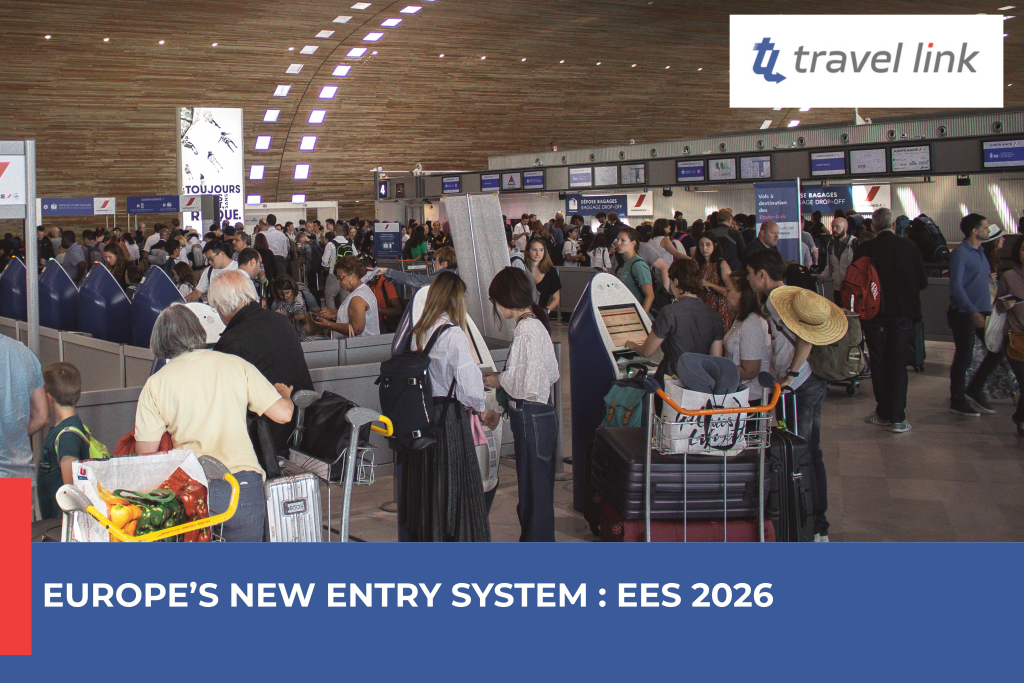
EES for UAE Residents: What You Need to Know in 2026
If you’ve flown into a Schengen country recently and had your fingerprints and photo taken at a kiosk instead of getting a passport stamp, that wasn’t a new airport gimmick. It’s the EU’s Entry/Exit System (EES). EES began phased implementation on 12 October 2025 and became fully operational at participating European external borders on 10 April 2026. Separately, ETIAS — the online pre-travel authorisation you may have heard is “coming soon” — is still not operational. The two are frequently confused, which can leave travellers unsure what actually applies to them before departure.
This guide separates EES, ETIAS and the Schengen visa clearly, and explains why UAE residence status by itself does not determine which of these applies to you.
Europe Entry Rules for UAE Residents — September 2026
EES
- Status: Active
- Who it affects: Most non-EU travellers on short stays, subject to specific exemptions
- Where: The 29 European countries that use EES (25 EU Member States plus Iceland, Liechtenstein, Norway and Switzerland)
- Cost: Free
ETIAS
- Status: Not active — no applications currently accepted
- Who it affects (once launched): Eligible visa-exempt travellers
- When required: Currently planned for the last quarter of 2026; exact date not yet confirmed
- Cost: €20 per application (once operational)
Schengen Visa
- Status: Active, as it has been for years
- Who needs it: Nationals whose passport is not visa-exempt for short Schengen stays
- Where to apply: Consulate or visa application centre before travel
UAE residence visa: Does not by itself determine EES, ETIAS or Schengen visa requirements. What determines them is your passport, your immigration/travel status, and any qualifying European documentation you hold.
EES ≠ ETIAS ≠ Schengen Visa
EES: A digital border entry/exit and biometric registration system for eligible non-EU short-stay travellers. Already operational. Not an advance authorisation and not a substitute for a Schengen visa.
ETIAS: A future pre-travel authorisation for eligible visa-exempt travellers. Not a visa. Not yet operational.
Schengen Visa: A visa required in advance for travellers whose passport nationality is not visa-exempt for short Schengen stays.
What Is EES?
The Entry/Exit System (EES) is the European Union’s digital system for recording the entry, exit and refusal-of-entry information of eligible non-EU short-stay travellers at the external borders of the Schengen Area, for stays of up to 90 days in any 180-day period. It replaces manual passport stamping for travellers within its scope. It is not a travel authorisation, there is no separate paid EES application, and it does not replace the requirement to hold a Schengen visa where one is needed.
Do UAE Residents Need EES?
Direct answer: EES requirements generally depend on a traveller’s passport, immigration/travel status and the type of European documentation they hold — not simply on UAE residence status.
If your passport requires a Schengen visa, or is currently visa-exempt for short Schengen stays, EES procedures apply to you at the border the same way they apply to anyone holding that passport, regardless of your UAE residence. What can change this is holding qualifying EU/Schengen documentation yourself — for example, a qualifying EU residence permit, a long-stay visa, or a qualifying residence card as a family member under EU free-movement rules. A UAE residence visa is not that kind of document, so it does not create an EES exemption on its own.
Does EES Apply If I Already Have a Schengen Visa?
Direct answer: Yes. Holding a Schengen visa doesn’t exempt you from EES — but the biometric process differs from that of a visa-exempt traveller.
- Schengen short-stay visa holders: Fingerprints are generally already stored in the EU’s Visa Information System (VIS) from the visa application. At the EES border check, these fingerprints can be verified against VIS rather than newly collected and stored again in EES. A facial image is used or captured as required under EES procedures.
- Visa-exempt travellers: Generally have four fingerprints registered where required and physically possible, along with a facial image.
Not every EES traveller goes through an identical biometric process — the visa-versus-visa-exempt distinction matters.
What Happens at First Registration?
Expect a first EES crossing to take a little longer than a manual stamp did. What’s collected depends on your situation, per the biometric distinction above: a facial image for all eligible travellers; new fingerprints for visa-exempt travellers where physically possible; VIS verification (not new collection) for Schengen visa holders; and travel document and entry/exit data for everyone in scope. The record is then linked to your travel document so later crossings are designed to be faster.
Children and EES
Children under 12 are exempt from the EES fingerprint requirement — this mirrors the age threshold used elsewhere in EU biometric travel-document rules. This is a fingerprint exemption specifically, not a blanket exemption from EES: a facial image may still be captured for a child in scope, and other entry/exit data is still recorded.
Can You Pre-Register for EES Before Flying from Dubai?
Direct answer: Only partially, and only for a limited number of destinations. It does not replace the border check anywhere.
The EU, through Frontex (the European Border and Coast Guard Agency), operates an official app called Travel to Europe. Eligible travellers can use it not earlier than 72 hours before the start of their journey to pre-register information supported by their destination.
Be precise about what this does and doesn’t mean:
- Availability is limited, not universal, and supported information differs by country. Each participating country decides independently whether and how to use the app, and which information it accepts through it.
- Sweden supports pre-registration of travel document data, facial-image registration and relevant entry information.
- Portugal currently supports a more limited feature set. Don’t assume every destination offers the same full biometric pre-registration Sweden does.
- Availability may expand as additional EES countries adopt the app.
- Using the app is voluntary, both for the traveller and the destination country.
- It does not eliminate the physical border check. You still complete identity verification at the border; the app is designed to make that step faster where it’s supported, not to remove it.
- It’s built for travellers within EES scope — it isn’t relevant if you hold a residence permit or long-stay visa that exempts you from EES.
Check the official EU travel-europe.europa.eu site for the current participating list before assuming it’s available for your route.
Will My Passport Still Be Stamped?
For travellers within EES scope, crossing at one of the 29 countries where EES operates, no — a digital entry/exit record replaces the manual stamp. Your entry/exit history now exists digitally rather than as passport pages, and that digital record is what border officers refer to going forward. This doesn’t apply outside EES-participating borders — Cyprus and Ireland, for instance, are not part of EES and continue to stamp passports in the normal way.
Does EES Cost Money?
No. EES registration is part of the standard, free border-control process — it is not a paid application and not something purchased in advance. There is no legitimate website charging a fee specifically for “EES registration”; the only EU-provided pre-registration tool is the free Travel to Europe app described above. (This is separate from legitimate paid visa consultancy services, which help with the visa application itself, and from the future ETIAS fee described below.)
Does EES Change the Schengen 90/180-Day Rule?
No. The rule is unchanged: up to 90 days within any rolling 180-day period across the Schengen Area. EES does not create a new stay allowance — it changes how entry and exit information is digitally recorded and monitored, which helps border authorities identify travellers who exceed the permitted 90 days. Travellers remain responsible for tracking their own stay.
Which Countries Use EES?
Direct answer: EES is used by 29 European countries — 25 EU Member States plus Iceland, Liechtenstein, Norway and Switzerland. Cyprus and Ireland do not currently use EES.
These 29 countries are the ones that operate the Schengen Area’s external border checks. Cyprus is an EU member state but is not part of this border-free zone and has not implemented EES. Ireland, also an EU member state, operates its own separate visa policy outside the Schengen Area and likewise does not use EES.
Does Cyprus Use EES? What About ETIAS?
Cyprus does not currently use EES. ETIAS, once operational, is intended to apply to a wider group of participating European countries that includes Cyprus — even though Cyprus remains outside EES and outside the Schengen Area’s border-free travel for now. Ireland is expected to remain outside both EES and ETIAS, operating its own separate visa policy. If your itinerary includes Cyprus, don’t assume EES (or later ETIAS) applies there the same way it applies in France, Germany or other Schengen destinations popular with UAE-based travellers.
Is ETIAS Required for UAE Residents in 2026?
Direct answer: No. ETIAS is not operational as of 21 September 2026, and no applications can currently be submitted anywhere. Once launched, whether it applies to a given UAE resident will depend on their passport nationality and travel status — not simply on holding UAE residency.
According to current European Commission guidance as of this review date, ETIAS is planned for the last quarter of 2026, with the exact date to be confirmed several months in advance. This timeline has shifted multiple times since ETIAS was first proposed in 2016, so Q4 2026 should be read as the current plan, not a guaranteed date. No legitimate website can currently issue an ETIAS authorisation — any site claiming otherwise is not official.
ETIAS Eligibility: Who It Will and Won’t Apply To
ETIAS is designed for eligible visa-exempt travellers only. It is not an additional requirement stacked on top of a Schengen visa. Two contrasting examples:
- Indian passport holder, UAE resident: Indian passport holders generally require a short-stay Schengen visa, unless a specific exemption applies. This traveller needs a Schengen visa and is subject to EES procedures at the border. Because ETIAS is designed for eligible visa-exempt travellers, it generally does not apply to Indian passport holders who require a Schengen visa, now or after launch, unless India’s visa-exemption status changes.
- Emirati passport holder, UAE resident: Emirati nationals are currently visa-exempt for short Schengen stays. This traveller does not normally need a Schengen visa, is subject to EES procedures at the border today, and will eventually need ETIAS once it becomes operational, subject to the applicable rules and exemptions at that time.
The distinguishing factor in both cases is passport nationality and visa-exemption status — not UAE residence, which both travellers share.
ETIAS Fee
ETIAS will cost €20 per application, a fee the European Commission confirmed on 17 July 2025 (raised from an original €7). Applicants under 18 or over 70 are exempt from paying the fee, although they may still need an ETIAS authorisation — the fee exemption and the authorisation requirement are separate things. An approved ETIAS authorisation will generally remain valid for three years or until the associated passport expires, whichever comes first.
EES vs ETIAS vs Schengen Visa
| EES | ETIAS | Schengen Visa | |
|---|---|---|---|
| Purpose | Digital border record of entries, exits and biometrics | Pre-travel security screening for eligible visa-exempt travellers | Advance permission to enter, issued by a consulate |
| Who it applies to | Most non-EU travellers on short stays, visa-required and visa-exempt alike, subject to specific exemptions (qualifying EU/Schengen residence permits, long-stay visas, qualifying family-member documentation under EU free-movement rules) | Only eligible nationals of currently visa-exempt countries | Only nationals who require a visa for short Schengen stays |
| Currently active? | Yes — fully operational since 10 April 2026 | No — planned for Q4 2026, exact date not confirmed | Yes, for years |
| Where it happens | At the physical border | Online, before travel (once launched) | Consulate or visa application centre, before travel |
| Advance application required? | No — border process only; optional voluntary pre-registration via Travel to Europe app where available | Yes, once operational | Yes |
| Biometrics | Facial image for all eligible travellers; new fingerprints for visa-exempt travellers where physically possible; Schengen visa holders’ fingerprints verified against existing VIS records | None | Fingerprints and photo captured at application, stored in VIS |
| Fee | None | €20 once live; under-18s and over-70s exempt from the fee, though an authorisation may still be needed; valid 3 years or until passport expiry | Standard Schengen visa fee, set separately |
| Replaces a visa? | No | No | N/A — it is the visa |
What UAE-Based Travellers Should Have Ready
- Keep passport details consistent across your Schengen visa (if required), airline booking, and any prior EU entry records.
- Check whether the Travel to Europe app covers your destination before relying on it — it isn’t universal.
- Track your own 90-day count. The visual passport-stamp check most travellers used is no longer how this works for EES-scope travel.
- If you’re visa-exempt today, there’s nothing to apply for regarding ETIAS yet — but plan for it if you have travel booked for late 2026 or 2027.
Border Discretion
EES registration does not guarantee admission, and holding a Schengen visa does not guarantee entry — border authorities retain responsibility for entry decisions in every case. Travel Link Relocation cannot influence EU processing times or approval decisions.
Planning a Schengen Trip from the UAE?
Travel Link Relocation can assist UAE residents with Schengen visa application preparation, document review, and guidance on current travel requirements. EES registration itself takes place through official European border procedures and does not require — and cannot be obtained through — a paid “EES application” from Travel Link or anyone else.
FAQs
Is EES the same as ETIAS? No. EES is an active biometric border-registration system. ETIAS is a separate, not-yet-operational online pre-travel authorisation for eligible visa-exempt travellers only.
Do UAE residents need EES? Most UAE-based non-EU travellers making a short stay in one of the 29 countries using EES will encounter the system at the external border, unless they fall under a specific exemption. It applies based on passport and travel status, not UAE residence.
Do UAE residents need ETIAS right now? No. ETIAS isn’t operational for anyone as of 21 September 2026.
Does EES apply if I already have a Schengen visa? Yes, though the biometric process differs — your VIS fingerprints are verified rather than retaken, and a facial image is captured.
Do Indian passport holders living in the UAE need EES? Yes. Indian passport holders generally require a Schengen visa, unless a specific exemption applies, and EES border procedures apply to Schengen visa holders regardless of UAE residence.
Do Indian passport holders need ETIAS? Generally no. ETIAS applies to eligible visa-exempt nationalities. Since Indian passport holders generally require a Schengen visa, ETIAS isn’t relevant to them unless that status changes.
Do Emirati passport holders need ETIAS? Not yet — ETIAS isn’t operational. Once it launches, Emirati passport holders, as currently visa-exempt nationals, are expected to need it, subject to the rules in force at that time.
Can I register for EES before travelling from Dubai? Only partially, via the EU’s free Travel to Europe app, and only where your destination participates. It doesn’t replace the border check.
Does EES cost money? No. It’s a free border-control process. Don’t pay any site or company for “EES registration.”
Does EES replace my Schengen visa? No. EES is a border procedure; a Schengen visa, where required, is a separate advance requirement.
Will my passport still be stamped? Not at borders where EES operates — a digital record replaces the manual stamp there. Countries outside EES, such as Cyprus and Ireland, continue to stamp passports as before.
Which countries use EES? 29 European countries: 25 EU Member States plus Iceland, Liechtenstein, Norway and Switzerland. Cyprus and Ireland do not currently use EES.
Does Cyprus use EES? No, not currently.
Does Ireland use EES? No.
Does EES change the 90/180-day rule? No — the rule is unchanged; EES only changes how compliance is tracked.
How much will ETIAS cost? €20 per application once operational. Under-18s and over-70s are exempt from the fee, though they may still need the authorisation itself. It will be valid for three years or until the passport expires.
Is the Travel to Europe app mandatory? No. It’s a voluntary pre-registration option, available only at a limited and growing number of destinations.
Last reviewed: 21 September 2026. European border and immigration systems can change, including ETIAS’s launch date and the countries and features supported by the Travel to Europe app. Confirm current requirements via the European Commission’s official travel-europe.europa.eu site or the relevant embassy/consulate before you travel.
Official Sources
- European Commission / Travel to Europe — “What is the EES?” — https://travel-europe.europa.eu/ees/what-is-ees_en
- European Commission / Travel to Europe — “Data held by the EES” — https://travel-europe.europa.eu/ees/data-held-ees_en
- European Commission / Travel to Europe — “To whom does EES not apply?” — https://travel-europe.europa.eu/ees/to-whom-does-ees-not-apply_en
- European Commission, Migration and Home Affairs — “European Travel Information and Authorisation System (ETIAS)” — https://home-affairs.ec.europa.eu/policies/schengen/smart-borders/european-travel-information-authorisation-system_en
- European Commission, Migration and Home Affairs — “The European travel authorisation ETIAS will cost EUR 20” (17 July 2025) — https://home-affairs.ec.europa.eu/news/european-travel-authorisation-etias-will-cost-eur-20-2025-07-17_en
- Frontex — “Travel to Europe” mobile app overview — https://frontex.europa.eu/what-we-do/etias-ees/travel-to-europe-app/
- Commission Implementing Decision (EU) 2025/1544 — EES start date, 12 October 2025 — https://eur-lex.europa.eu/eli/dec_impl/2025/1544/oj